
‘Three Minor Engines’ children’s book upends the meritocracy fantasy
A staple of U.S. elementary university school rooms, The Very little Motor That Could has taught children for generations about resilience in the experience of wrestle. The ethical of the basic tale, about a plucky locomotive that helps make its way as a result of an arduous mountain journey by repeating “I-believe-I-can, I-assume-I-can” (to the cadence of a chugging steam teach) fosters the thought that, via hard function and a can-do angle, any one can obtain anything.
It’s element of a vision that has pervaded American tales due to the fact the country’s founding. But, like several of those legends, it may dismiss the actuality that some men and women basically do not have the usually means to propel them selves to achievements as very easily as other individuals. So, Bob McKinnon, a lecturer, author, and podcaster whose do the job focuses on the topic of social very good, has penned what he phone calls a more “nuanced” model of the story: an homage, but one that accounts for the critical variants in people’s lives. He hopes that by becoming capable to comprehend our have journeys, we can better empathize with people of other folks, and be extra ready to supply help—especially as we assess the struggles people today have suffered all through the pandemic.
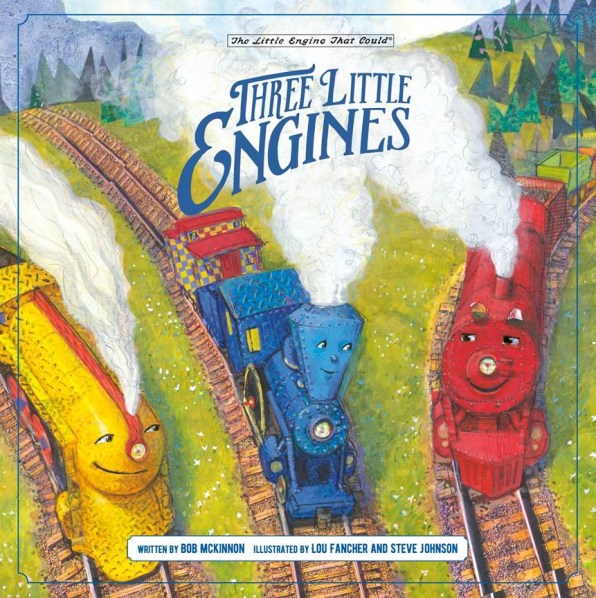
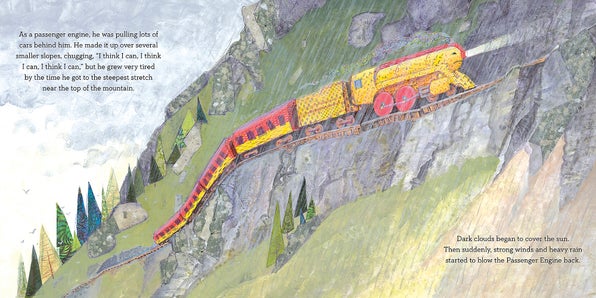
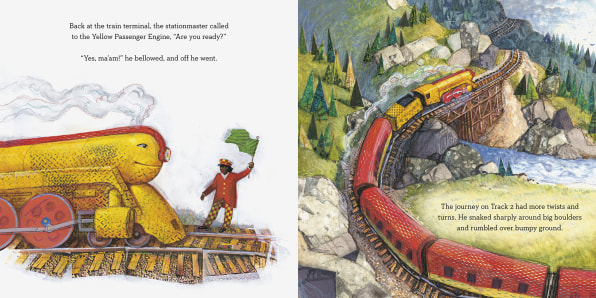
At its main, The Minimal Engine That Could focuses on a sort, caring protagonist, a coach that will help other folks while much better and superior-equipped trains go by with excuses. McKinnon says his new tale, Three Minor Engines, could be considered as an origin tale, to explain why that identified blue engine does have the heart to offer assistance to his fellow trains. In McKinnon’s tale, it is graduation day for 3 locomotives, which have to make a closing journey about a mountain to satisfy their teacher. The blue engine is joined by two pals, a confident yellow engine and a brawny red 1. The blue engine would make it by means of minimal trials and reaches the other stop: “I think I can…Merrily, she puffed down the mountain, achieving the village devoid of any trouble.” But, the other two—who have to pull weighty hundreds, climb steep and winding routes, and confront blocks on their tracks—do not. “As [the yellow engine] tried using to force ahead, he chattered, ‘I, I, I, consider, feel, believe, I can, can—can’t,’” the story reads. “He could not go a different inch.”
Not thinking of the distinctive obstructions they faced, the blue motor miracles if her good friends just hadn’t attempted tricky sufficient. Her instructor, the rusty motor, tells her to think about her individual path, inquiring questions like, “Did you deal with wind and rain?” “How hefty was your load?” “Was there just about anything blocking your keep track of?” She lastly will come to the conclusion that her pals worked seriously tricky, as well. “But they acquired trapped. Just due to the fact you feel you can, doesn’t often mean you will, does it?” Upon her realization, she goes back again to enable her buddies, and they all graduate with each other.
McKinnon wrote the story to “inspire people to reflect on who and what has contributed to wherever they finish up in daily life,” which is also the crux of the social mobility analysis he does with his nonprofit, Going Up Media Lab. It all begun when he viewed as how his good friends, who commenced in roughly identical areas, had “dramatically distinctive everyday living results.” That qualified prospects you to contemplate your have route in lifetime, like the blue engine. By mulling above her possess journey, she was then in a position to consider others’ relative struggles. “What I had appear to explore,” McKinnon says, “was that if persons did not initial have a very good understanding of how they came to stand in their very own footwear, that empathy would be far too significantly a leap.”
The e-book, which is produced July 13, is firmly rooted in social science investigation, significantly in a psychological theory recognised as attribution theory. That idea proposes that when we seem for good reasons for our good results, we have a tendency to more than-emphasize our “disposition,” or our internal features, alternatively than our “situation,” or any exterior factors—like economical aid from spouse and children, connections created by means of close friends or networks, and luck. He refers to a psychology analyze that commenced some Monopoly gamers off with additional money than their opponents—like a head start off in existence. Those people gamers, who ultimately won, viewed person agency as the main bring about for their results none credited their fantastic fortune. This mindset also influences how we view others’ mobility. In the story, the blue engine’s “first inclination is this fundamental attribution bias,” McKinnon suggests. “Where are they? Are they not doing the job hard?”
Illustrated by Lou Fancher and Steve Johnson, the photograph e-book is aimed at small children aged three to seven, because for McKinnon, it’s significant to relay these messages at an early age. “I really do not feel kids are born essentially considering, ‘it’s only about me,’” he states. Somewhat, cultural influences generate hyper-individualistic attitudes—especially in The us, where “bootstraps” myths and historical retellings are core to the nation’s DNA. But McKinnon (who took place to grow up in the very same city as the iconic “rags-to-riches” storyteller Horatio Alger), claims American stories are loaded with situational components that go overlooked. In Rocky, for occasion, the little-time boxer receives a opportunity in the ring only mainly because of a further fighter’s harm (“The complete film hinges on luck!” McKinnon claims) in Hamilton, the lyric, “Took up a assortment just to ship him to the mainland,” illustrates how the founding father was bestowed revenue to get to colonial The usa. Nevertheless it all gets credited to particular person brilliance.
“I observed this thought of exceptionalism getting essentially a limiting perception,” McKinnon says. Ultimately, the hyper-focus on the personal can be unsafe in conditions of how we see some others. McKinnon wants young persons to request what instances introduced a particular person to be homeless, for instance, rather of concluding they did not function hard adequate. And then, ideally, to consider how they can assistance. In the story, the vital turning stage arrives when the blue motor decides to enable his friends, emphasizing a sense of local community that’s normally silenced in the American best. “I-imagine-I-can” results in being “I-feel-we-can.”
There have been situations in American historical past that the “we” has prevailed more than the “I,” McKinnon claims, principally in periods of hardship, this kind of as right after the Great Despair, with the emergence of the New Deal. He hopes this will also be the situation as we get better from the COVID-19 pandemic, and wonders if we’ll see spikes in volunteering, mentoring, and governing administration and philanthropic action. Even so, the essential will be to commence with our personal pandemic encounters, and not downplay the hardships we’ve all been through—but, instead, empathize with others’ relative struggles without judgement. As individuals about us test and recoup from their own treacherous journeys, he suggests, “Maybe we want to go again up the mountain and say, ‘Hey, is there some thing we can do?’”


