
How to get around in Paris
Paris has an endless array of things to see and do – so it’d be understandable if you want to pack as much into every day as possible. Luckily, walking is a pleasure in Paris, and the city also has one of the most efficient and inexpensive public-transport systems in the world, making getting around a breeze. Want to explore the City of Lights? Here’s our handy guide to getting around in Paris.
Walking
Paris is a beautiful city to explore on foot, with many top attractions within walking distance if you’re staying centrally. However, even if your accommodation is further away, you can walk around your arrondissement, and then take a variety of transportation options to get to whatever attractions you’d like to visit.
Bike
Paris is increasingly bike-friendly, with more cycling lanes and efforts from the City of Paris to reduce the number of cars on the roads.
The Vélib‘ bike-share scheme puts tens of thousands of bikes (30% of which are electric) at the disposal of Parisians and visitors at some 1400 stations throughout Paris, accessible around the clock. To get a bike, you first need to purchase a one- or seven-day subscription either online (generally EU credit cards only) or at the docking stations. After you authorise a deposit (€300) to pay for the bike should it go missing, you’ll receive an ID number and PIN code and you’re ready to go. Bikes are rented in 30-minute intervals. If you return a bike before a half-hour is up and then take a new one, you will not be charged for a standard bicycle (electric bikes incur charges).
Bus
Buses can be a scenic way to get around – and there are no stairs to climb, meaning they are more widely accessible – but they’re slower and less intuitive to figure out than the metro.
Paris’ bus system, operated by the RATP, runs from approximately 5am to 1am Monday to Saturday; services are drastically reduced on Sunday and public holidays. Hours vary substantially depending on the line.
Paper tickets will be phased out by 2022, replaced by contactless cards. Normal bus rides embracing one or two bus zones cost one metro ticket; longer rides require two or even three tickets.
Whatever kind of single-journey ticket you have, you must validate it in the ticket machine near the driver. If you don’t have a ticket, the driver can sell you one for €2 (correct change required).
Metro and commuter trains
Paris’ underground network is run by RATP and consists of two separate but linked systems: the metro and the Réseau Express Régional (RER) suburban train line. The metro has 14 numbered lines; the RER has five main lines (but you’ll probably only need to use A, B and C).
When buying tickets consider how many zones your journey will cover; there are five concentric transport zones rippling out from Paris (zone 5 being the furthest); if you travel from Charles de Gaulle Airport to Paris, for instance, you will have to buy a ticket for zones 1 to 5.
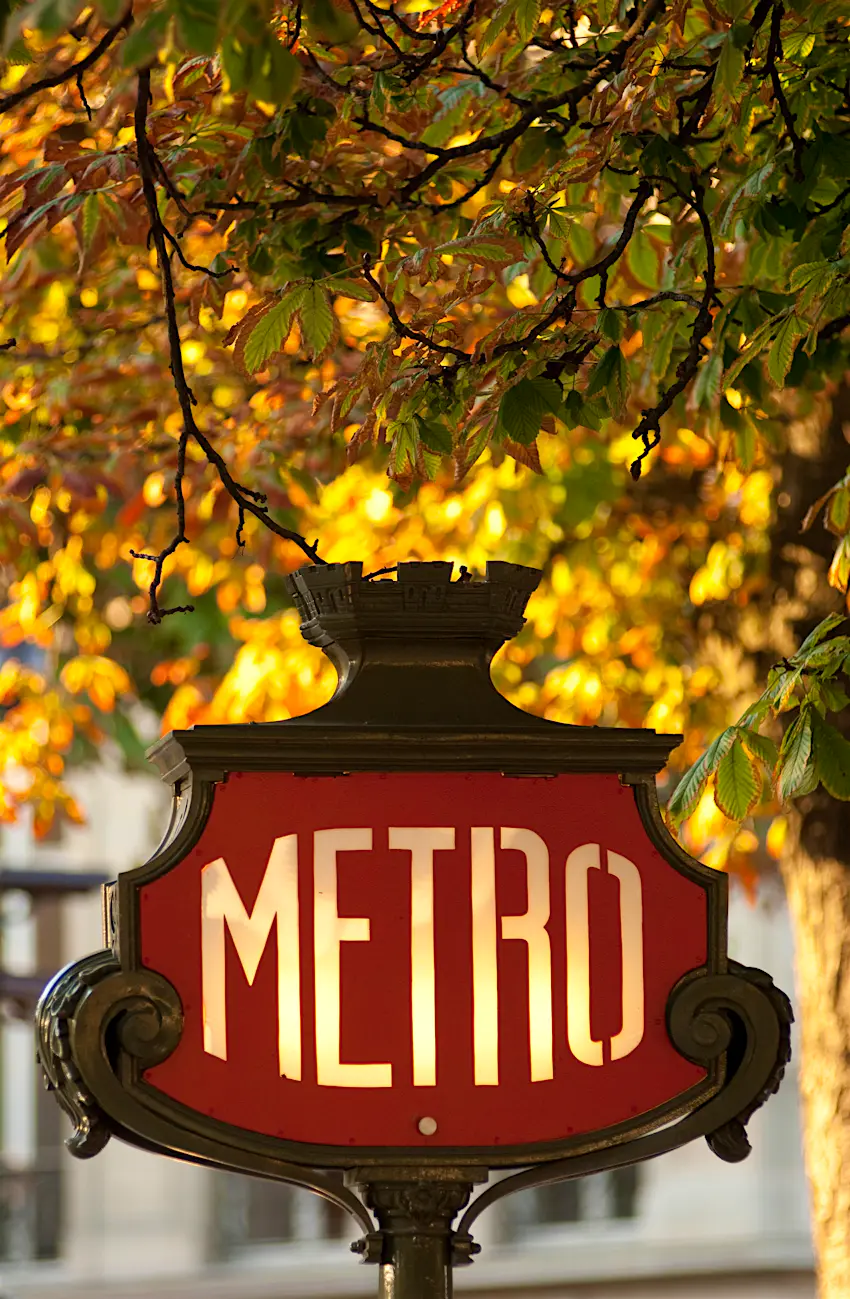
Metro maps of various sizes and degrees of detail are available for free at metro ticket windows; several can also be downloaded for free from the RATP website.
The RER is faster than the metro, but the stops are much further apart. Some attractions, particularly those on the Left Bank (eg the Musée d’Orsay, Eiffel Tower and Panthéon), can be reached far more conveniently by the RER than by the metro.
Metro lines are identified by both their number (eg ligne 1 – line 1) and their colour, listed on official metro signs and maps.
Signs in metro and RER stations indicate the way to the correct platform for your line. The direction signs on each platform indicate the terminus. On lines that split into several branches (such as lines 7 and 13), the terminus of each train is indicated on the cars and on signs on each platform giving the number of minutes until the next and subsequent train.
Signs marked correspondance (transfer) show how to reach connecting trains. At stations with many intersecting lines, like Châtelet and Montparnasse Bienvenüe, walking from one platform to the next can take a very long time. Different station exits are indicated by white-on-blue sortie (exit) signs. You can get your bearings by checking the plan du quartier (neighbourhood maps) posted at exits.
Each line has its own schedule, but trains usually start at around 5.30am, with the last train beginning its run between 12.35am and 1.15am (2.15am on Friday and Saturday), with all-night services under consideration..
If you’re going out to the suburbs (eg Versailles or Disneyland), ask for help on the platform – finding the right train can be confusing. Also make sure your ticket is for the correct zone.
Tickets and passes
Mobilis day tickets and Paris Visite tourist passes cover transport. If you’re staying in Paris for longer than a few days, the cheapest and easiest way to use public transport is to get a combined travel pass that allows unlimited travel on the metro, the RER and buses for a week, a month or a year. Passes cover all of the Île-de-France (that is, all zones).
Navigo, like London’s Oyster card or Hong Kong’s Octopus card, is a system that provides you with a refillable weekly, monthly or yearly unlimited pass that you can recharge at machines in most metro stations. To pass through the station barrier, swipe the card across the electronic panel as you go through the turnstiles. Standard Navigo passes, available to anyone with an address in Île-de-France, are free but take up to three weeks to be issued; ask at the ticket counter for a form or order online via the Navigo website. Otherwise, pay €5 for a Navigo Découverte (Navigo Discovery) card, which is issued on the spot but (unlike the standard Navigo pass) is not replaceable if lost or stolen. Both passes require a passport photo and can be recharged for periods of one week or more.
A weekly pass costs €22.80 and is valid Monday to Sunday. It can be purchased from the previous Friday until Thursday; from the next day weekly tickets are available for the following week only. Even if you’re in Paris for three or four days, it may work out cheaper than buying carnets (books of tickets) and will certainly cost less than buying a daily Mobilis or Paris Visite pass. The monthly pass (€75.20) begins on the first day of each calendar month; you can buy one from the 20th of the preceding month. Both are sold in metro and RER stations from 6.30am to 10pm and at some bus terminals.
Car and motorbike
Driving in Paris is defined by the triple hassle of navigation, heavy traffic and limited parking. Petrol stations are also difficult to locate and access. A car is unnecessary to get around, but if you’re heading out of the city on an excursion, then one can certainly be useful. A Crit’Air Vignette (compulsory anti-pollution sticker) is also required in most instances. If you plan on hiring a car, it’s best to do so online and in advance.

To enter the city within the bd Périphérique (ring road) between 8am and 8pm Monday to Friday, a Crit’Air Vignette (compulsory anti-pollution sticker) is needed for all cars, motorcycles and trucks registered after 1997, including foreign-registered vehicles. Older vehicles are banned during these hours. The sticker is not necessary for the ring road itself.
There are six colour-coded stickers, ranked according to emissions levels, from Crit’Air 1 to the highest-polluting Crit’Air 6. In instances of elevated pollution levels, vehicles with stickers denoting higher emissions are banned from entering the city. Fines for not displaying a valid sticker start at €68.
For full details and to order stickers online, visit the website, available in multiple languages including English. You’ll need to upload a copy of your vehicle’s registration certificate. Allow time for it to be mailed to your home. Prices for a Crit’Air Vignette start at €3.62.
Taxi
The flagfall is €4 (€7 for advance bookings). Within the city limits, it costs €1.12 per kilometre for travel between 10am and 5pm Monday to Saturday (Tarif A; white light on taxi roof and meter).
At night (5pm to 10am), on Sunday from 7am to midnight and during peak travel times (7am to 10am and 5pm to 7pm Monday to Saturday) in the central 20 arrondissements, the rate is €1.38 per kilometre (Tarif B; orange light).
Travel in inner Paris on Sunday night (midnight to 7am Monday) and in the outer suburbs is at Tarif C, €1.61 per kilometre (blue light). The minimum taxi fare for a short trip is €7.30.
There are flat-fee fares to/from the major airports (Charles de Gaulle from €53, Orly from €32).
Flagging down a taxi in Paris can be difficult; it’s best to find an official taxi stand. To order a taxi, call or reserve online with Taxis G7 or Alpha Taxis. An alternative is private driver system Uber taxi; you order and pay via your phone.
Boat
Batobus are glassed-in trimarans that dock every 20 to 25 minutes at nine small piers along the Seine: Eiffel Tower, Invalides, Musée d’Orsay, St-Germain des Prés, Notre Dame/Latin Quarter, Jardin des Plantes, Hôtel de Ville, Musée du Louvre and place de la Concorde.
Buy tickets online, at ferry stops or at tourist offices. Two-day passes must be used on consecutive days.You can also buy a Pass+ that includes L’Open Tour buses, to be used on consecutive days. A two-day pass per adult/child costs €47/21; a three day-pass is €51/21.
Accessible transportation in Paris
Paris is an ancient city and therefore not particularly well equipped for some visitors with disabilities: curb ramps are few and far between, older public facilities and budget hotels usually lack lifts, and the metro, dating back more than a century, is mostly inaccessible for people who use wheelchairs.
Efforts are being made to improve things, however. The tourist office continues its excellent ‘Tourisme & Handicap’ initiative, under which museums, cultural attractions, hotels and restaurants that provide access, special assistance or facilities for those with physical, cognitive, visual and/or hearing disabilities display a special logo at their entrances. Online, its FACIL’iti service allows you to create your own profile to personalise the web content of parisinfo.com according to your particular motor, sensory and/or cognitive needs.
The Paris Convention and Visitors Bureau’s main office is equipped with a service called ACCEO, which makes it possible for people who are deaf or hearing impaired to ask for information. With the help of a French sign-language operator, users can communicate via a webcam, microphone and speakers. Instant speech transcription is available, too.


