
Trip frequency is important component in new legislation of human vacation
As a scientist, you from time to time appear throughout a locating that is apparent and strong, revealing a pattern that was right in front of you all along — and which would make you want to kick you for not noticing it before. The common visitation law of human mobility, described in Nature by Schläpfer et al.1, is just this sort of a acquiring. The authors uncover a pattern of human conduct that connects journey distance to the frequency of excursions.
Take into consideration any two sites. Can we forecast how lots of individuals journey from just one to the other, and vice versa, on the basis of the placement and uncomplicated characteristics of the two destinations? This question is at the core of a substantial overall body of literature whose origin dates again to the mid-nineteenth century. In 1885, the geographer Ernst Ravenstein confirmed empirically that two essential features describe the selection of folks who go in between any two places2: the length in between the destinations, and the socio-economic properties of the origin and vacation spot. The quantity of travellers tends to lower with length, for instance, and more-populated destinations draw in a lot more travellers.
These important observations have been later on integrated into the gravity legislation of human mobility, which states that the variety of travellers among two cities improves with a energy of the cities’ populace sizes, and decreases with a power of the distance between them3. A refinement of the gravity legislation, regarded as the radiation design, proposes that the range of travellers does not depend immediately on the distance among two metropolitan areas, but somewhat on the quantity of spots amongst the metropolitan areas at which individuals would realistically quit4.
Research into human mobility has flourished in the previous couple of years, as a final result of details getting to be readily available with increasingly high-quality spatial and temporal resolution5. This has authorized scientists to alter the radiation and gravity products, and a myriad of variants, to seize vacation designs on a variety of timescales, which includes house relocation (residential mobility), airline vacation, city transportation and commuting. Schläpfer and colleagues now report a basic discovery in this extremely active place of analysis. They have discovered a critical ingredient that was lacking from current theoretical frameworks of human mobility: visitation frequency (f), the quantity of outings that somebody makes to a place per unit of time.
The authors built their discovery by reframing the challenge faced by modellers. As a substitute of concentrating exclusively on distance and sociodemographic options, they questioned a even more issue: ‘How a lot of people residing in any supplied position vacation to any other place just n moments in a time period T?’ This modify in point of view is feasible for the reason that mobility info for men and women are now readily available from cell-phone monitoring. By researching mobility traces extracted from telephones at 7 city locations about the environment, the authors uncovered a phenomenological law that responses their concern: the selection decreases with r2 (the place r is the length from someone’s residence to a presented place), and with f2, where by f = n/T (Fig. 1).
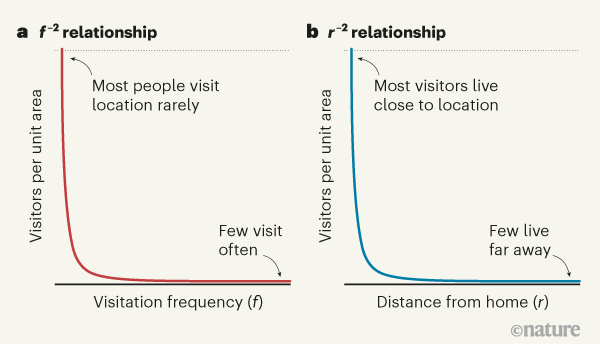
Determine 1 | A universal law of human mobility. Schläpfer et al.1 analysed cellular-cell phone monitoring facts to identify the designs of human journeys in numerous cities. a, The authors discover that, for folks who are living at a certain length r from a unique spot, the selection of persons for every unit region who vacation with a visitation frequency f to that place is inversely proportional to f2. b, An inverse-square relationship is also observed for the distance from dwelling, r, given a precise visitation frequency f. That is, for persons who travel with a presented frequency of outings f to a specific locale, the range of folks for each unit spot who vacation a distance r from home is inversely proportional to r2. The noticed associations hold for any option of area, r and f. The graphs demonstrated are illustrations of the noticed interactions, and do not signify true facts.
Remarkably, this law is valid for all the commonly distinct urban devices viewed as in the analyze, and as a result provides a typical framework for describing and predicting mobility flows across timescales. Importantly, the model accommodates various mobility behaviours, from commuting to residential mobility, without having requiring a adjust of parameters.
To comprehend how the noticed sample emerges robustly from the multitude of unique behaviours, Schläpfer et al. formulated a model of the mobility of people that incorporates practical and nicely-recognized mechanisms, these as people’s inclination to discover spots that are well-known with other guests, and preferential return — an empirical phenomenon in which the selection of visits gained by a location is proportional to the quantity of visits formerly acquired6. This design reproduces the collective designs of mobility noticed in the telephone info. By linking the mobility of people to collective results, the authors’ do the job can help to slim the hole involving two streams of literature that have previously been broadly distinctive5. The results therefore pave the way for scientific studies that could deepen our theoretical understanding of how particular person and collective mobility styles are related.
One unanswered concern is whether or not the patterns of mobility noticed in city areas also implement outdoors towns. The geographies of rural regions are fewer centralized and have fewer places of curiosity to website visitors than do urban places these features may well final result in travel styles distinctive from people observed by Schläpfer and colleagues. A different critical question is irrespective of whether mobility styles are distinct for journeys that are not anchored to people’s residences.
In their modelling of vacation designs, the authors suppose that people today head straight residence after checking out any location. But in the actual environment, geographical considerations and the require to decrease travel time have a tendency to result in trips in certain reccurring sequences. People frequently take a look at sites in a specified order, for case in point likely from perform to the grocery store and health and fitness center, and then household. We as a result foresee that types that capture the buying of excursions will be critical to furnishing a actually extensive description of collective mobility flows throughout area and time, and even more precise predictions of authentic-entire world behaviour. In the meantime, we hope the mobility designs uncovered by Schläpfer et al. to be handy for a wide range of purposes, from epidemic modelling to transportation scheduling and city design.
Competing Pursuits
The authors declare no competing passions.


